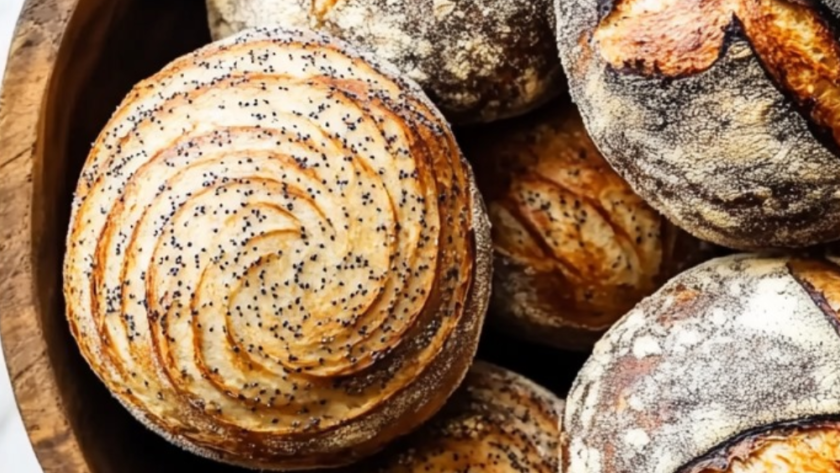
This bread takes three days and I am telling you upfront so you do not start it at 6pm expecting toast by morning. Martha Stewart’s Sourdough Bread uses a homemade levain, 750 grams of bread flour, a long autolyse, six rounds of stretch-and-fold, an overnight cold proof, and a screaming hot Dutch oven at 500 degrees to produce two golden, crackly boules.
I make this bread recipe a few times a year when I have a weekend with nothing scheduled. It is not hard, it is just slow. Most of the time you are waiting, not working, and the smell that fills your kitchen on bake day makes every hour of patience worth it.
Try More Bread Recipes:
Why You Will Love This Sourdough Bread:
- No yeast packet, just your starter: Martha uses wild yeast from a sourdough starter instead of store-bought yeast. You build a levain the night before and let it ferment for 10 to 12 hours. That slow fermentation is what gives the bread its tang, its chew, and that open crumb you see in bakery loaves. I was nervous the first time I relied on a jar of bubbly starter to raise bread, but it worked.
- The autolyse makes the dough easier to handle: Before you add salt, Martha has you mix the flour and water and just walk away for 30 minutes to 4 hours. The flour absorbs the water on its own and starts building gluten without any effort from you. When I skip this step the dough is sticky and uncooperative. When I do it, the dough almost folds itself.
- The Dutch oven does the bakery work: Preheating a Dutch oven to 500 degrees and baking inside it with the lid on traps steam around the loaf. That steam is what gives you a shatteringly crisp crust and a soft inside. I do not have a bread oven. I have a regular Dutch oven and it works perfectly.
Sourdough Bread Ingredients
- 50 grams fed sourdough starter (about 1/4 cup)
- 75 grams unbleached bread flour, plus more for dusting (for levain)
- 75 grams lukewarm water (for levain)
- 575 grams lukewarm water (for dough)
- 750 grams unbleached bread flour (for dough)
- 17 grams fine sea salt
How To Make Martha Stewart Sourdough Bread
- Build the levain (Day 1, evening): Mix the 50 grams of starter with 75 grams of bread flour and 75 grams of lukewarm water in a large bowl. Cover with a damp kitchen towel and let it sit at room temperature for 10 to 12 hours overnight.
- Make the autolyse (Day 2, morning): Add 525 grams of the lukewarm water to the levain and stir until it dissolves. Add all 750 grams of bread flour and mix with a scraper and your hands until no dry flour remains. The dough should not feel too wet or sticky. If it does, add a little more flour. Cover and let it rest at room temperature for at least 30 minutes and up to 4 hours.
- Add the salt: Dissolve the 17 grams of sea salt in the remaining 50 grams of water. Pour it over the dough and squeeze it in with your hands until fully incorporated. Cover and let stand 30 minutes.
- Stretch and fold: With damp hands, grab the underside of the dough, stretch it up and out, and fold it back over itself. Rotate the bowl a quarter turn and repeat 6 more times. Cover and let rest 30 minutes. Repeat this entire process 5 more times with 30-minute rests between each set. After the final fold the dough should be soft and elastic. Let it rest 30 minutes more. This step takes about 3 1/2 hours total.
- Shape the loaves: Turn the dough out onto a lightly floured surface. Divide it into two pieces with a bench scraper or knife. Shape each into a loose round and let them rest 10 minutes. Flour 2 banneton baskets or kitchen-towel-lined bowls. Fold the edges of each dough piece into the centre like an envelope, flip it seam-side down, and use both hands to drag it toward you while tucking the edges under to build tension until the round is taut and smooth. Transfer seam-side up into the prepared baskets.
- Cold proof (Day 2, evening to Day 3): Cover with damp kitchen towels and refrigerate for at least 8 hours and up to 1 day.
- Preheat (Day 3): Line a 6-quart or larger Dutch oven with a square of parchment paper. Cover with the lid and place it in the oven on a lower rack. Preheat to 500 degrees. Take the dough out of the fridge while the oven heats. It does not need to come to room temperature.
- Bake with lid on: Carefully invert one dough round seam-side down into the hot Dutch oven. Score the top with a bread lame, razor, or sharp knife. Drop a couple of ice cubes on top for extra steam if you like. Cover and bake at 500 degrees for 20 minutes. Reduce the temperature to 450 degrees and bake with the lid on for 10 more minutes.
- Bake with lid off: Remove the lid and continue baking until the crust is dark golden brown and the loaf sounds hollow when you tap the bottom, about 15 to 25 more minutes.
- Cool and repeat: Transfer the loaf to a wire rack and let it cool completely before slicing. Let the Dutch oven cool for 10 minutes, clean it out, and repeat the entire baking process with the second loaf.
Recipe Tips
- Feed your starter the day before: Martha says to always feed the starter a day before you plan to mix the levain. If it has reliably doubled in volume after feeding and looks stretchy and webby, it is ready. I have skipped this once and the bread barely rose.
- Reserve 50 grams of water for the salt: Martha splits the 575 grams of water into two amounts on purpose. The 525 grams goes into the autolyse. The remaining 50 grams dissolves the salt and goes in later. This is not a mistake in the recipe, it is the method. I dumped all the water in at once my first time and the salt did not distribute evenly.
- Line the Dutch oven with parchment: It keeps the dough from sticking to the bottom and makes it easy to lift the loaf out after baking. I forgot parchment once and spent 20 minutes chipping bread off the bottom of the pot.
- Do not slice until it cools completely: I know it is torture. The bread is still cooking inside from residual heat and cutting it open releases all the steam. The crumb will be gummy if you slice too early. I set a timer for 45 minutes and leave the room.
The Second Loaf Is Always Better
Someone who made this said the first attempt was the hardest recipe they had done in a long time but the second go turned out much better. I had the exact same experience. The first loaf I was nervous about every step and the shaping was sloppy. By the second loaf I had the feel for the dough and the confidence to handle it properly.
If your first boule comes out dense or flat, make it again. The recipe works. Your hands just need to learn it.
What Goes Well With This Sourdough
A thick slice of this with cream of tomato soup is the best lunch I know how to make. The crust holds up to dunking and the crumb soaks up the soup without falling apart.
I also toast slices and serve them alongside scrambled eggs for breakfast. Good sourdough toast does not need much. Butter and salt.
How To Store Leftovers
Wrap the cooled loaf tightly and keep it at room temperature for 2 to 3 days. The crust softens after day one but the bread is still good for toast and sandwiches.
Cut it into quarters or slice it before freezing and it keeps for about a month. I always slice before freezing so I can pull out exactly what I need for toast without thawing the whole thing.
FAQs
- What is a levain? It is the French word for sourdough. In this recipe, Martha uses it as the first step: a specific amount of starter, flour, and water mixed together, left to ferment overnight, and then used completely in the dough. Think of it as waking up your starter and giving it a big meal before it goes to work.
- Can I bake both loaves at the same time? Only if you have two Dutch ovens. Martha bakes one at a time because the pot needs to be screaming hot when the dough goes in. I do not own two, so I bake the second loaf right after the first one comes out.
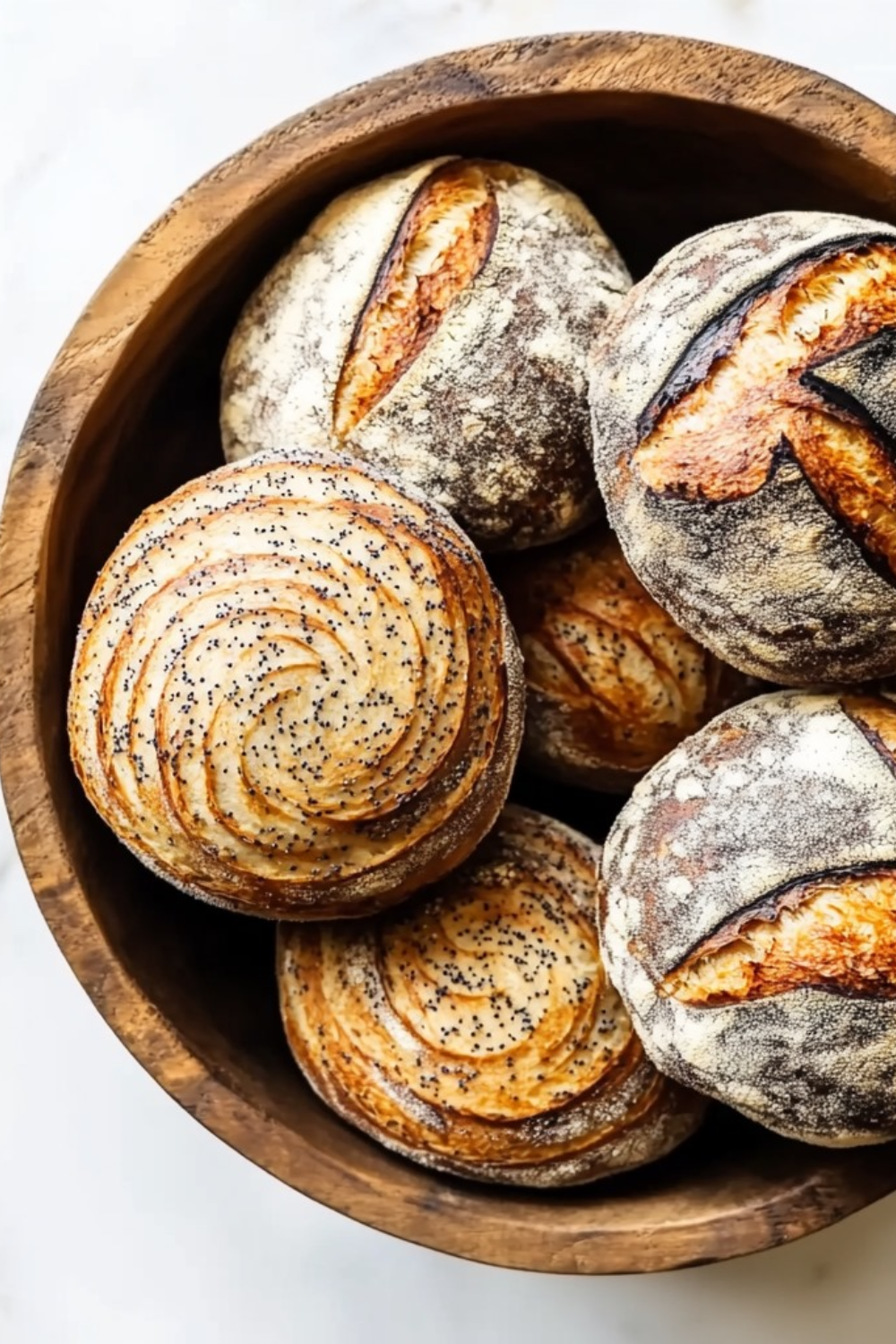
- Do I need a banneton basket? No. Martha says you can use a bowl lined with a floured kitchen towel. I used a bowl the first few times and it worked fine. The banneton gives you those pretty ring patterns on the crust but it does not change the taste.
- Can I freeze the bread? Yes. Slice it first, put the slices in a freezer bag, and freeze for up to a month. Individual slices thaw quickly in the toaster. Wrap it tight or you will get that sad freezer crust on the surface.
More Bread Recipes:
Nutrition Facts
(1 slice, makes about 16 slices total from 2 loaves)
- Calories: 170
- Total Fat: 0.5g
- Saturated Fat: 0g
- Cholesterol: 0mg
- Sodium: 290mg
- Total Carbohydrates: 36g
- Protein: 5g
Martha Stewart Sourdough Bread Recipe
Description
This bread takes three days and I am telling you upfront so you do not start it at 6pm expecting toast by morning. Martha Stewart’s Sourdough Bread uses a homemade levain, 750 grams of bread flour, a long autolyse, six rounds of stretch-and-fold, an overnight cold proof, and a screaming hot Dutch oven at 500 degrees to produce two golden, crackly boules.
I make this bread recipe a few times a year when I have a weekend with nothing scheduled. It is not hard, it is just slow. Most of the time you are waiting, not working, and the smell that fills your kitchen on bake day makes every hour of patience worth it.
Ingredients
Instructions
- Build the levain (Day 1, evening): Mix the 50 grams of starter with 75 grams of bread flour and 75 grams of lukewarm water in a large bowl. Cover with a damp kitchen towel and let it sit at room temperature for 10 to 12 hours overnight.
- Make the autolyse (Day 2, morning): Add 525 grams of the lukewarm water to the levain and stir until it dissolves. Add all 750 grams of bread flour and mix with a scraper and your hands until no dry flour remains. The dough should not feel too wet or sticky. If it does, add a little more flour. Cover and let it rest at room temperature for at least 30 minutes and up to 4 hours.
- Add the salt: Dissolve the 17 grams of sea salt in the remaining 50 grams of water. Pour it over the dough and squeeze it in with your hands until fully incorporated. Cover and let stand 30 minutes.
- Stretch and fold: With damp hands, grab the underside of the dough, stretch it up and out, and fold it back over itself. Rotate the bowl a quarter turn and repeat 6 more times. Cover and let rest 30 minutes. Repeat this entire process 5 more times with 30-minute rests between each set. After the final fold the dough should be soft and elastic. Let it rest 30 minutes more. This step takes about 3 1/2 hours total.
- Shape the loaves: Turn the dough out onto a lightly floured surface. Divide it into two pieces with a bench scraper or knife. Shape each into a loose round and let them rest 10 minutes. Flour 2 banneton baskets or kitchen-towel-lined bowls. Fold the edges of each dough piece into the centre like an envelope, flip it seam-side down, and use both hands to drag it toward you while tucking the edges under to build tension until the round is taut and smooth. Transfer seam-side up into the prepared baskets.
- Cold proof (Day 2, evening to Day 3): Cover with damp kitchen towels and refrigerate for at least 8 hours and up to 1 day.
- Preheat (Day 3): Line a 6-quart or larger Dutch oven with a square of parchment paper. Cover with the lid and place it in the oven on a lower rack. Preheat to 500 degrees. Take the dough out of the fridge while the oven heats. It does not need to come to room temperature.
- Bake with lid on: Carefully invert one dough round seam-side down into the hot Dutch oven. Score the top with a bread lame, razor, or sharp knife. Drop a couple of ice cubes on top for extra steam if you like. Cover and bake at 500 degrees for 20 minutes. Reduce the temperature to 450 degrees and bake with the lid on for 10 more minutes.
- Bake with lid off: Remove the lid and continue baking until the crust is dark golden brown and the loaf sounds hollow when you tap the bottom, about 15 to 25 more minutes.
- Cool and repeat: Transfer the loaf to a wire rack and let it cool completely before slicing. Let the Dutch oven cool for 10 minutes, clean it out, and repeat the entire baking process with the second loaf.
Notes
- Feed your starter the day before: If it has doubled in volume after feeding and looks stretchy, it is ready.
- Reserve 50 grams of water for the salt: The 525g goes into the autolyse, the 50g dissolves the salt later.
- Line the Dutch oven with parchment: Prevents sticking and makes it easy to lift the loaf out.
- Do not slice until it cools completely: The bread is still cooking inside from residual heat.